OUTDOOR CLASSROOM
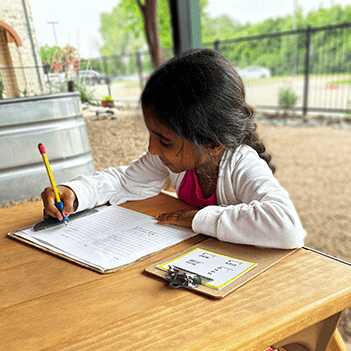
Students can choose to work with Montessori materials in the classroom courtyards or practice natural gross motor movements, such as balancing on a beam or walking a labyrinth.

Wildscape
Students have many opportunities to explore our 5-acre wildscape, learning about plants, insects, and other wildlife who visit this wondrous space.
GARDENING AND ANIMAL CARE
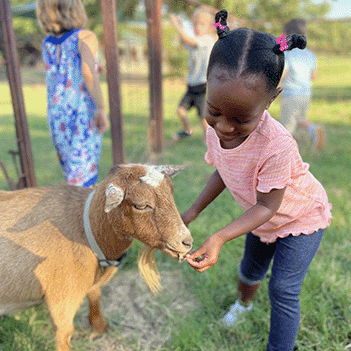
Our students fully engage in caring for our pig, Rufus, and our chickens on a daily basis. Students are also active participants in planting, maintaining, and growing fruits and vegetables in our gardens.
Nontraditional Learning
Children thrive in both our indoor and outdoor classrooms where curiosity about the world drives them to learn. We provide professional guidance, the prepared environment, and scientifically developed materials for children to live
up to their full potential.
Learning Happens through purposeful activity
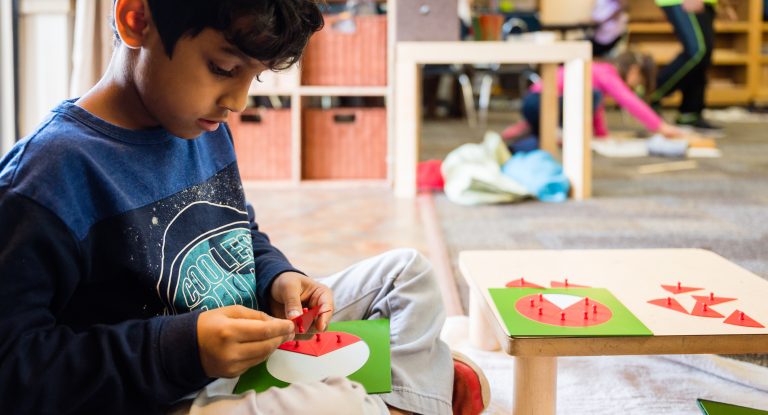
Children work with specially designed learning materials, manipulating and investigating them to master the lessons they embody.
abstract ideas in concrete form
Children use real objects to translate abstract ideas into concrete form. The example above, the binomial cube, physically represents a mathematical equation, which is (a + b)³ = (a + b) (a + b) (a + b) = a³ + 3a²b + 3ab² + b³.
OPPORTUNITIES FOR Outdoor learning
We are lucky to have a safe and secure 13-acre campus which provides students with many opportunities to work and play outside. Each classroom also has an exterior door, so students have access to the prepared outdoor learning environment daily.
Committed professionals
Our committed and credentialed professionals foster a child’s cognitive, physical, and social/emotional well-being, leading children to become enthusiastic, intrinsically motivated learners.
TMA at a Glance
Our Global Community Celebrating DEIB
Maria Montessori’s educational philosophy, emphasizing equality, inclusivity, and the empowerment of marginalized communities, was rooted in the belief that every child, regardless of their background, deserves access to quality education. With students and staff members representing more than 20 countries, we consider TMA to be a small-scale global community.
Highly Committed Teachers
29% of our teachers are in their second decade of service at TMA, while the average tenure of lead classroom teachers at TMA is 9 years. The average tenure of all teaching staff at TMA is 7.5 years.
Accreditation
TMA is fully accredited by the American Montessori Society. We are 1 of only 4 fully accredited schools in the DFW area. There are only 11 schools in Texas that hold this level of accreditation.
“The child who has never learned to work by himself, to set goals for his own acts, or to be the master of his own force of will is recognizable in the adult who lets others guide his will and feels a constant need for approval of others.”
– Maria Montessori, Education and Peace
A Walk through Early Childhood
What does a typical day look like?
Indoor Classroom
Students engage in academic and other purposeful work using hands-on, scientifically developed materials.
Outdoor Classroom
Students engage in academic work, gardening, animal care, gross motor development, and imaginative play.
TMA Programs
Lower and Upper School
Developmental stages of learning are at the core of a Montessori education. Our Lower School is designed for children between 6 weeks and 6 years of age, and our Upper School is for children between 6 and 12 years old. Within each school, there are programs designed to enhance learning for each specific developmental stage.
Process vs. Product Based Learning
The Lower School provides a prepared Montessori environment and curriculum which encourages self-directed, experiential learning, where children are learning how to learn, in preparation for the elementary years.
The Upper School focuses on more product and project-based learning with expectations of mastery. Students work independently, cooperatively, and collaboratively to develop the Portrait of a Graduate attributes. The teacher works as a guide to create an academic work plan based on observations of individual student progress from which children can choose how to schedule their day and follow their interests. While all programs at TMA are authentically Montessori and aligned with AMS accreditation standards, there are unique elements that have been added to the Elementary program that facilitate the transition of students to more traditional educational settings once they leave TMA.
Infant – 6 weeks to 18 months
Toddler – 18 months to 3 years
Early Childhood – 3 to 6 years
Lower Elementary – 6-9 years
Upper Elementary – 9-12 years
A Peek Inside
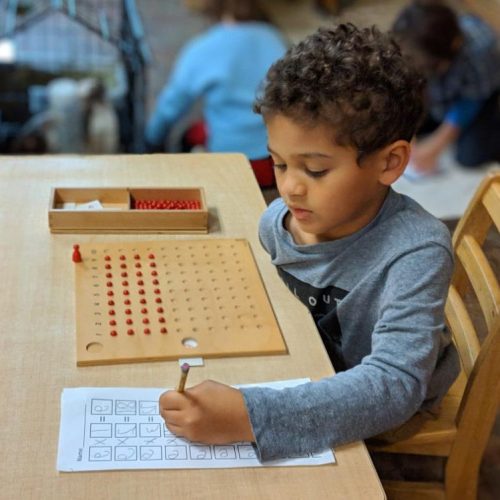
Early Childhood Multiplication Board
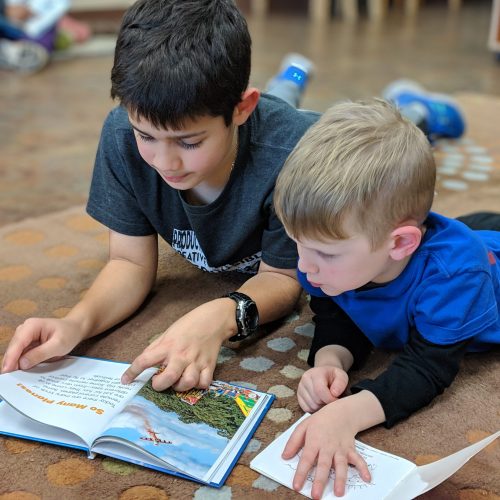
Elem & Early Childhood Reading Buddies
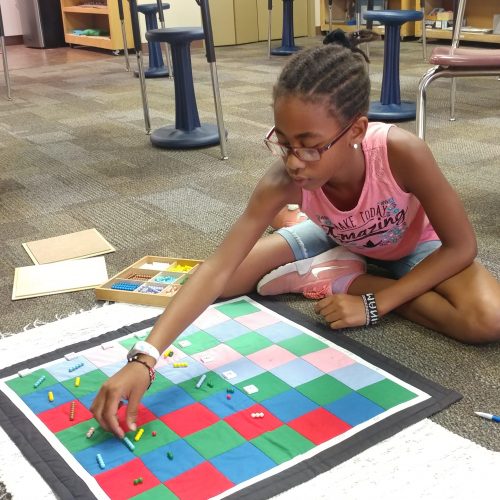
Upper Elementary Decimal Multiplication

Early Childhood Sandpaper Letters

Infant Peer Interactions

Early Childhood Preparing Snack

Lower Elementary Botany
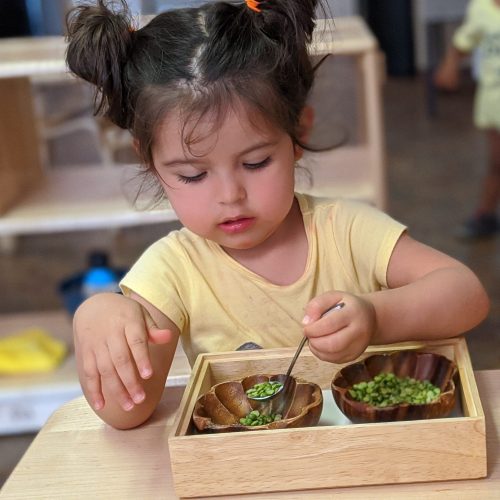
Toddler Transferring

Early Childhood Wet Pouring

Infant Imbucare

Early Childhood Easel Painting
FAQs
We have gathered some of the most frequently asked questions in one place to make finding information easier for prospective parents. This information is covered in greater detail in our Family Guide or other locations of our website. We encourage prospective families to read through these questions and sign up for a visit to find out even more details about our programs.
We are open between 7:00 am and 6:00 pm, Monday through Friday. The school day is from 8:30 am to 3:30 pm, with Before Care from 7:00-8:30 am and Extended Day from 3:30-4:30 pm or Extended Day Plus from 3:30-6:00 pm.
During the summer, our Extended Day hours are slightly reduced – Before Care begins at 7:30 am, and Extended Day Plus ends at 5:30 pm.
Yes. Tuition can be paid in-full or on a monthly basis. If parents choose to pay on a monthly basis, parents are required to purchase tuition insurance, which is 2.6% of the annual tuition, paid one time each year with each new contract, and is due with your first tuition payment in May.
Yes. Our enrollment contracts begin in August and end in May, with an option to add the summer months. If you are admitted after the beginning of a school year, your tuition is pro-rated based on when you enroll.
Each new school year begins in August and closely follows the Arlington ISD school calendar. We offer enrollment throughout the school year on a space-available basis, with tuition being pro-rated for those who start later in the year.
Our ratios vary by program:
— Infant – 1:4 (2 teachers for 8 students)
— Toddler – 1:8 (2 teachers for 16 students)
— Early Childhood – 1:12 (2 teachers to 24 students)
— Elementary – 1:18 (1 teacher for up to 18 students)
While these are the minimum ratios, we have an additional teacher available for each of the Infant, Toddler, and Early Childhood classrooms throughout the day. Elementary students also participate in Enrichment classes with Enrichment Specialist teachers.
All families provide their own healthy lunch options for their children.
Parents provide snacks and lunch for children enrolled in the Infant program.
A few times each year, families with students enrolled in the Toddler and Early Childhood programs will receive a list of groceries to purchase to bring for the classroom snack. As part of the Practical Life work in class, students will prepare snack each day.
Elementary students will bring snacks for themselves each day.
The nap schedule for infants is individualized and based on an infant’s age and need.
Toddlers and 3- and 4-year-old Early Childhood students take a nap in the afternoon, after lunch.
Early Childhood students who are 5-years-old take part in special enrichment classes and have another work cycle in the afternoon.
Parents of children with diagnosed allergies or asthma are required to provide the school with an individualized health care plan, signed by the child’s medical provider. A list of children with medically documented food allergies is posted in every classroom throughout the school, and a list of the classroom allergens is posted outside of each room.
TMA was established as a parent cooperative and, as such, requires parental involvement. Not only does community service help to build stronger bonds between community members, but it also provides excellent modeling for the volunteerism that we wish to instill in our students.
Parents pay a Community Service Fee of $300 each year, $150 for the fall term and $150 for the spring term. If one or more members of your family volunteer at TMA for 5 hours each semester or 10 hours for the year, you will be refunded the entirety of the Community Service Fee, or you may contribute it to the Scholarship Fund.
To protect the health of all children and to satisfy state regulations, current medical information for each child is required prior to enrollment. These records, which must meet state immunization and hearing and vision screening requirements, need to be updated when new screenings or immunizations are given. An annual physical is required for children in the Infant, Toddler and Early Childhood programs.
The state of Texas allows certain immunization exemptions and we follow all state guidelines.
Several forms of communication are used to meet the needs of our community. These include email, texting, phone calls, written documentation, parent/teacher conferences, a parent portal on our website, a closed Facebook group, and Bloomz, a photo/video sharing app so parents can catch glimpses of the work their children are completing.
We produce a weekly e-newsletter to keep parents informed about school-wide activities and events which is available via email, text, our closed Facebook group, the parent portal, and through a communication app called Bloomz.
For infants, in additional to daily, in-person communication, teachers record when diapers were changed, meals/snacks were eaten, and naps were taken in the Bloomz app.
Injuries will be promptly treated by a staff member and parents will be notified either by telephone or through a copy of a completed Accident/Incident Report form. Parents will receive a short report which documents how, when, and where and accident or incident occurred.
Students are prepared to succeed wherever they go for middle school. The elementary program provides opportunities for students to practice time management, collaboration, and problem-solving skills on a daily basis, enabling them to adapt to their new schools, whether private, public, or parochial. Want to hear directly from alumni how their transitions were? Check out our Alumni Thoughts page!
4 Easy Steps to Admission
Our admissions team will lead you through the entire process to answer your questions and provide all the information you need so your family can make an informed decision about whether TMA is the right choice for your child and your family. We understand that choosing the right school is an extremely important decision and we will be here to guide you through the decision-making process.
Schedule a Visit
All of our visits are scheduled online and held during the morning hours so visitors can observe students during their morning work cycle. Parents will have a chance to ask questions and the Tuition and Fee Schedule will be discussed.
Apply Online
After visiting, a link to complete an online application will be sent. Upon submission of the application and non-refundable $75 application fee, the Head of School meeting will be scheduled. For those applying for the Early Childhood and Elementary programs, student shadow days will also be scheduled.
Meet with the Head of School
During the 30-minute meeting, fit and match between the family’s expectations for their child and TMA’s vision is explored. Information about the shadow days (if applicable) and a detailed tuition payment schedule will be discussed.
Complete Online Enrollment
Upon acceptance to TMA, the enrollment process begins with an offer to enroll. Families then complete their Online Enrollment forms and pay the non-refundable $325 Registration Fee. Enrollment is complete after the first tuition payment has been received.
What do parents say about TMA?
We are happy with TMA, my child has been attending the school and he has learned so much. The school environment is clean and has so much for my son who loves to be in outdoors. Teachers and the administrators are helpful.
Great Schools
After touring over a dozen preschools, TMA came out on top for us. We love the focus on teaching important life skills and building character, not just behavior. The teachers interact with the students in a way that helps them to become independent and thoughtful little people.
Google Reviews
This is a GEM in the middle of the metroplex, with acres of nature surrounding the school. Kids are given a unique opportunity to experience and enjoy nature in a caring environment, while learning so much, both in and out of the classroom. Our child really likes it here.
Niche Reviews
TMA is a great school that helps students gain independence, learn concepts deeply, and become well-rounded citizens of the world. The teachers are dedicated, and the campus is beautiful and inviting. TMA is a great place to be!
Private School Review